
Written by Christine Blosdale - The Expert Authority Coach™
Have you sent podcast pitches that disappeared into the void?
Are you brilliant at what you do, yet somehow still overlooked by the shows your ideal clients listen to?
Do you keep wondering how to get podcast guest opportunities without sounding desperate, salesy, or exactly like everyone else?
You're not imagining it. Podcast guesting is competitive in 2026.
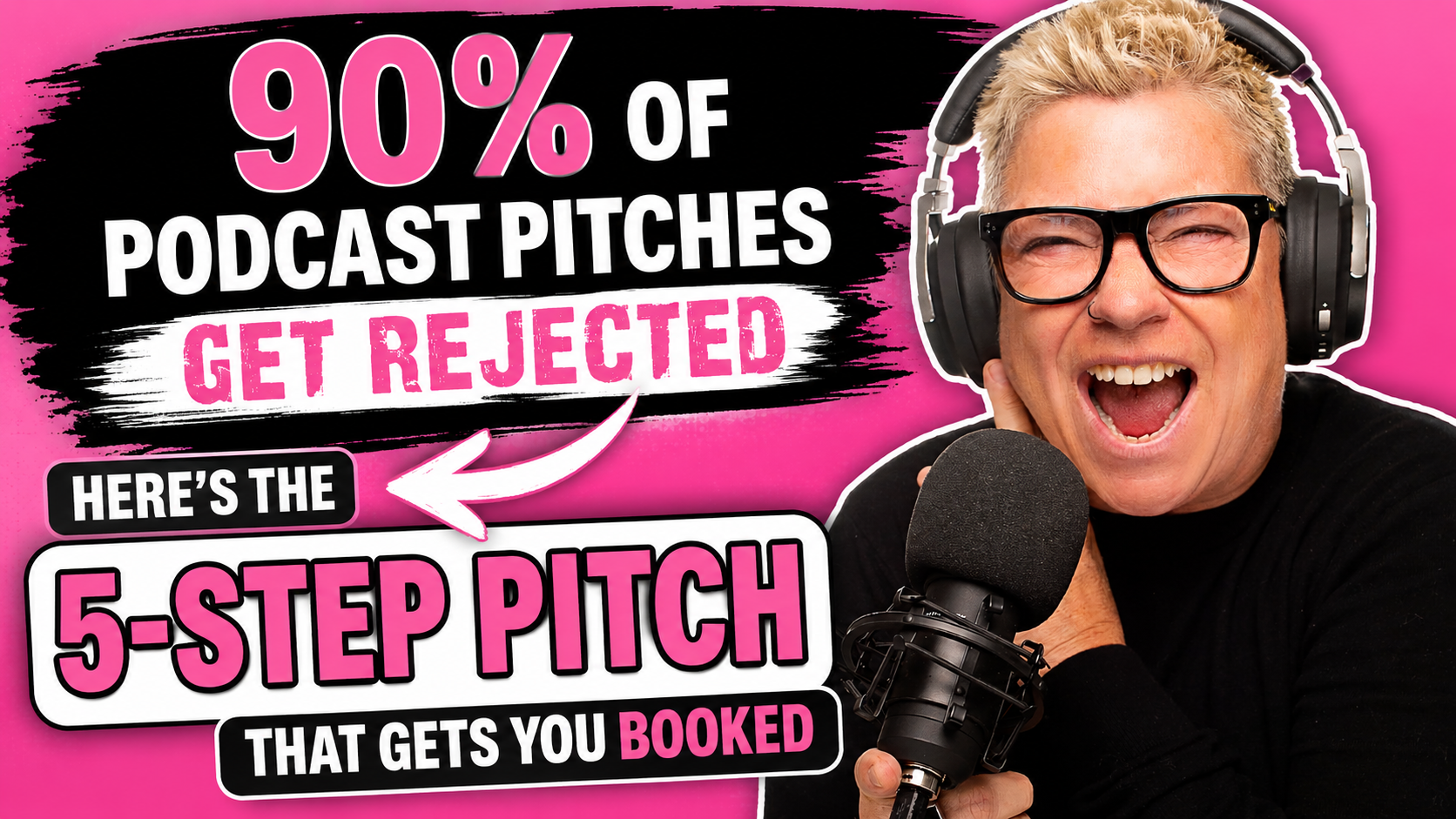
One recent industry report puts the median podcast guest acceptance rate at approximately 5%. That means roughly 95% of pitches don't result in a booking. Other industry reporting commonly uses the “90% rejected” benchmark to describe the reality hosts and producers are seeing every week.
But here's the important part:
Most podcast pitches aren't rejected because the person isn't qualified. They're rejected because the pitch gives the host no compelling reason to say yes.
That’s where your strategy changes.
After more than twenty-five years in personal branding, broadcasting, and media, including creating content for America Online and Microsoft, I know what happens behind the scenes. Hosts aren't simply looking for impressive résumés.
They’re looking for guests who understand their audience, respect their format, and can deliver a conversation their listeners will remember.
So let's talk about the podcast guesting strategy that gets you out of the ignored pile and into the “let's book her” pile.
THE PROBLEM: Your Pitch Is Probably Too Focused on You
I see this all the time.
A brilliant coach, consultant, speaker, author, or thought leader sends a pitch that begins with:
> “I’m a bestselling author with twenty years of experience, multiple certifications, and a proven framework…”
That information may be true. It may even be impressive.
But the host is immediately asking:
Will this person connect with my listeners?
Do they have a fresh perspective?
Can they communicate clearly?
Will this conversation be useful, engaging, or memorable?
Have they actually listened to my show?
A podcast host isn't booking your résumé.
They’re booking a conversation.
According to research from Podseeker’s podcast research guide, approximately 36% of declined pitches are rejected because the guest is simply the wrong fit. That’s why sending more pitches isn’t always the answer.
A mediocre pitch to the right show can outperform a polished pitch sent to the wrong audience.
Why Most Podcast Pitches Get Rejected in 2026
The pattern is remarkably consistent.
Most pitches fail because they are:
Generic enough to send to any podcast
Focused on the guest’s credentials instead of listener value
Missing a clear episode idea
Sent to shows with no audience alignment
Written without researching recent episodes
Overly long, formal, or obviously AI-generated
Missing a simple reason for the host to respond
And please hear me on this: using AI to help you draft isn't the problem.
The problem is sending a pitch that sounds like nobody in particular wrote it.
Your lived experience, your point of view, and your ability to see what your audience needs are what make you magnetic. The technology can support your thinking. It cannot replace it.
THE SOLUTION: A Five-Step Podcast Pitch Framework
This is the podcast guesting strategy I recommend when you want quality opportunities, not random appearances.
STEP 1: Choose the Right Show Before You Write Anything
Start with your ideal audience, not your ego.
The biggest podcast in your industry may not be the best show for you. A smaller podcast with a highly engaged audience of your ideal clients can create more trust, referrals, and opportunities than a large but disconnected audience.
Before adding a show to your pitch list, ask:
Does the show reach the people I want to serve?
Is the podcast active and publishing consistently?
Does the host regularly interview guests?
Have they covered topics adjacent to mine?
Can I offer a fresh angle rather than repeating an old conversation?
Look for alignment in three areas:
Audience
Topic
Format
If even one of those is completely off, move on.
Depth beats breadth. Ten right-fit shows will usually outperform one hundred random pitches.
STEP 2: Research Two or Three Recent Episodes
This is the step most people skip. It’s also the step that immediately separates you from the majority of pitchers.
Listen to or carefully review two or three recent episodes. Then make notes on:
The host’s interview style
The questions they ask repeatedly
The topics they return to
The kind of guests they feature
What the audience appears to care about
Any gaps you could help fill
You don't need to become a podcast scholar.
You do need to know enough to say something more meaningful than, “I love your show.”
Research is respect.
STEP 3: Offer One Strong Episode Concept
Don't send a menu of twelve possible topics.
That creates work for the host.
Offer one clear, relevant episode concept with a title that makes the value obvious.
For example:
> Suggested episode: From Hidden Expert to Go-To Authority: How to Become More Visible Without Becoming More Salesy
Then explain what the audience will learn:
Why being excellent isn't enough if your message is unclear
How to identify the authority gap in your positioning
What to say when introducing your work
How to become more visible without posting constantly
The first three visibility moves to make in the next 30 days
Notice what this does.
It gives the host a useful idea, an easy way to imagine the episode, and tangible takeaways for listeners.
You're not saying, “Put me on your show.”
You're saying, “Here is a conversation your audience may genuinely need.”
STEP 4: Prove You Can Deliver the Conversation
Now you can briefly explain who you are.
Keep this section short. One or two sentences are enough.
Your credibility should answer one question:
Why are you the right person to speak about this particular topic?
For me, that might sound like:
> “I’m Christine Blosdale, The Expert Authority Coach™, with more than twenty-five years in personal branding, broadcasting, and media. As a former content creator for America Online and Microsoft, I help women experts get seen, trusted, and paid for what they already know.”
That’s enough.
You don't need to include every credential, award, client, certification, or career milestone. The host can explore your story during the interview.
If relevant, add one line about the practical recording experience you bring:
> “I have a professional microphone, quiet recording space, reliable internet, and experience delivering clear, engaging interviews.”
This matters because many podcasts are now video-first. Hosts want guests who can show up prepared, technically ready, and comfortable on camera.
STEP 5: Make the Next Step Easy
Your final line should be simple and low-pressure.
Try:
> “Would this be a fit for an upcoming episode? I’d be happy to send a brief outline or work around your booking process.”
Then include:
Your website
Your media page or speaker page
One or two relevant appearances (if you have them)
Your social links
A professional headshot, if requested
Don't attach a giant media kit unless the host asks for one.
And don't end with a complicated calendar link, five offers, and a full sales funnel.
The goal of the first pitch is a conversation about a booking, not a complete conversion event.
Your Five-Step Pitch Template
Here’s the framework in one place:
Subject: A fresh idea for [Podcast Name]: [specific episode concept]
Hi [Host Name],
I enjoyed your recent episode about [specific topic], especially [specific detail]. It connected with a question I hear often from [the audience you serve]: [relevant question or challenge].
I’d love to suggest an episode on [clear episode title].
Your listeners would learn:
[Takeaway one]
[Takeaway two]
[Takeaway three]
I’m [name], a [short description of your role]. I help [audience] [specific result], and my work is informed by [relevant experience or credibility].
Would this be a fit for an upcoming episode? I’d be happy to send a short outline.
Warmly,
[Name]
[Website]
Keep the final version concise. In most cases, aim for approximately 100–175 words.
What to Do After You Send the Pitch
No response doesn't always mean no.
Hosts are busy. Some receive dozens of pitches every week. Some are booking months ahead. Others are managing production, sponsorships, editing, and promotion themselves.
Send one thoughtful follow-up approximately seven days later.
Keep it short:
> Hi [Name], just circling back on the episode idea below. I think your audience would especially appreciate the practical section on [specific takeaway]. Happy to send a brief outline if useful.
If you still don't hear back, you can send one final follow-up another seven to ten days later.
Then release the outcome.
Your authority is not determined by one host’s inbox, one busy season, or one unanswered email.
And remember: some “no” responses have nothing to do with your quality. The show may be full, changing direction, taking a break, or not booking guests at the moment.
THE ADVANTAGE: Become the Guest Hosts Remember
The best podcast guesting strategy isn't about chasing every opportunity.
It’s about becoming unmistakable to the right host.
That means:
You understand the show before you pitch it
You bring an original idea, not a generic topic
You focus on the audience, not just your credentials
You communicate with warmth and clarity
You show up prepared to create a genuinely useful conversation
This is how podcast guesting becomes more than visibility.
It becomes trust-building.
A listener hears you explain a problem they’ve been struggling with. They recognize your point of view. They feel the calm confidence behind your expertise.
And suddenly, you're no longer a stranger on the internet.
You’re the expert they remember.
Turn Your Expertise Into More Than a Pitch
You already have the knowledge.
You may already have the stories, the framework, the client results, and the perspective your audience needs. What you may not have is the positioning that makes those strengths easy for a host to recognize.
That’s the work I do.
For more than twenty-five years, I’ve helped entrepreneurs, coaches, authors, speakers, and thought leaders move from overlooked to unmistakable. Podcast guesting can be part of that visibility plan, but it works best when your message, positioning, and authority are aligned first.
If you're ready to stop guessing and start positioning yourself like the authority you already are, the next step is simple.

👉 Book Christine’s complimentary consultation — a $250 value — and visit ExpertAuthorityCoach.com to learn more about how she helps experts get seen, trusted, and paid.
You don't need to become louder to get booked. You need to become clearer, more relevant, and easier to remember.
Your voice is valuable.
Now let’s make sure the right people hear it.